
Gian Marco Montesano
1949, Turin, Italy
Gian Marco Montesano is one of the most recognisable figures in contemporary Italian painting. Painter, writer and theatre director, over the years he has built a personal language combining memory, cinema, photography and European history. After a long period spent in Paris, he now lives and works between Rome and Bologna.
His works often look like film stills suspended in time: interiors, faces, flowers, urban scenes and images belonging to the collective imagery of the twentieth century. Black and white, a central element of his research, recalls period cinema and historical photography, but without decorative nostalgia.
Montesano paints images that feel familiar even when we don't quite know why. His work brings together visual elegance, personal memory and a reflection on how images continue to inhabit our history.
He has taken part in the Venice Biennale and his works are held in major international public and private collections.
Gian Marco Montesano
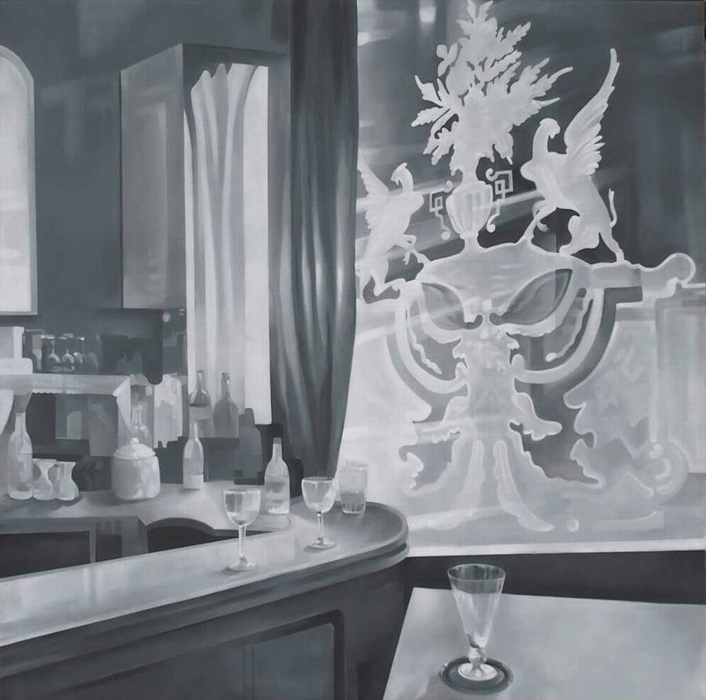
Cafe de Paris, 2007
Oil on canvas,
200 × 200 cm.
In Cafe de Paris, everything seems frozen for a moment. The counter, the glasses left on the tables, the bottles, the heavy curtains, even the large illuminated sign on the glass all seem to belong to a scene just abandoned by someone.
Montesano builds an almost cinematic setting, immersed in a soft, milky black and white that recalls old post-war European photographs. There is no confusion, no movement. And yet the painting is full of human presence, even without showing it directly.
Looking at it up close, one gets the sense of stepping into a real, lived-in place, with an atmosphere that is elegant but also melancholic. The light reflected on the glass and the tables makes the scene remarkably physical. It is one of those paintings that change depending on how long you stand in front of them: first the image strikes you, then personal memories, associations and imagined stories begin to surface.
In Stefano Rastrelli's collection, this work carries exactly that: the allure of cinema, of memory, and of certain European places that seem to belong to the past and the present at once.
Gian Marco Montesano
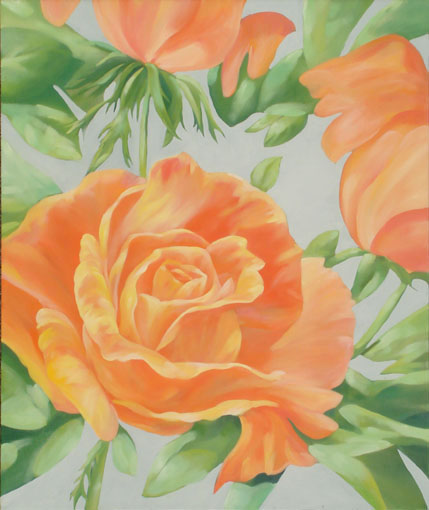
Grazie dei fiori, 2007
Oil on canvas,
120×100 cm.
At first glance it looks like a simple floral image. A large orange rose, luminous, almost delicate. But looking closer, one realises Montesano is not simply painting a flower.
The image recalls certain popular Italian prints, old calendars, brochures from the 1960s and 70s, those reassuring, familiar images that belong to the collective memory of many people. The rose fills almost the entire canvas and loses something of its natural quality, becoming presence, icon, memory.
The colours are soft, gently blurred, as if time had worn the image down without erasing it. It is precisely this ambiguity that makes the work so compelling: it is romantic and, at the same time, strangely distant, like a photograph found again after many years.
In the Grazie dei fiori cycle, Montesano manages to turn a simple subject into something far deeper - not through spectacular effects, but by using images that belong to our most everyday visual memory.