
Luigi Mainolfi
1948, Rotondi (Avellino), Italy
Luigi Mainolfi is one of the most consistent and visionary figures in Italian contemporary art. After completing his training in Naples in the 1970s, he moved to Turin, a city that became the centre of his experimental research. From his earliest works he stood out for a language uniting gesture, body and sculpture, moving between performance and the archetypal.
From the 1980s onward, Mainolfi developed a personal mythology grounded in raw materials, organic forms and fairy-tale references. Polychrome terracotta became one of his favoured materials, a symbol of a sculpture that is born from the earth and remains in dialogue with it. His works, though anchored in an archaic dimension, speak a contemporary, intimate language, building landscapes of memory in which the skin of the sculpture is both body and map.
Tied by origin to Campania, like Stefano Rastrelli, the artist carries with him the warmth of a popular culture intertwined with the depth of a refined sculptural thought. He has exhibited at the Venice Biennale (1982), at Documenta in Kassel, and in prestigious Italian and European institutions.
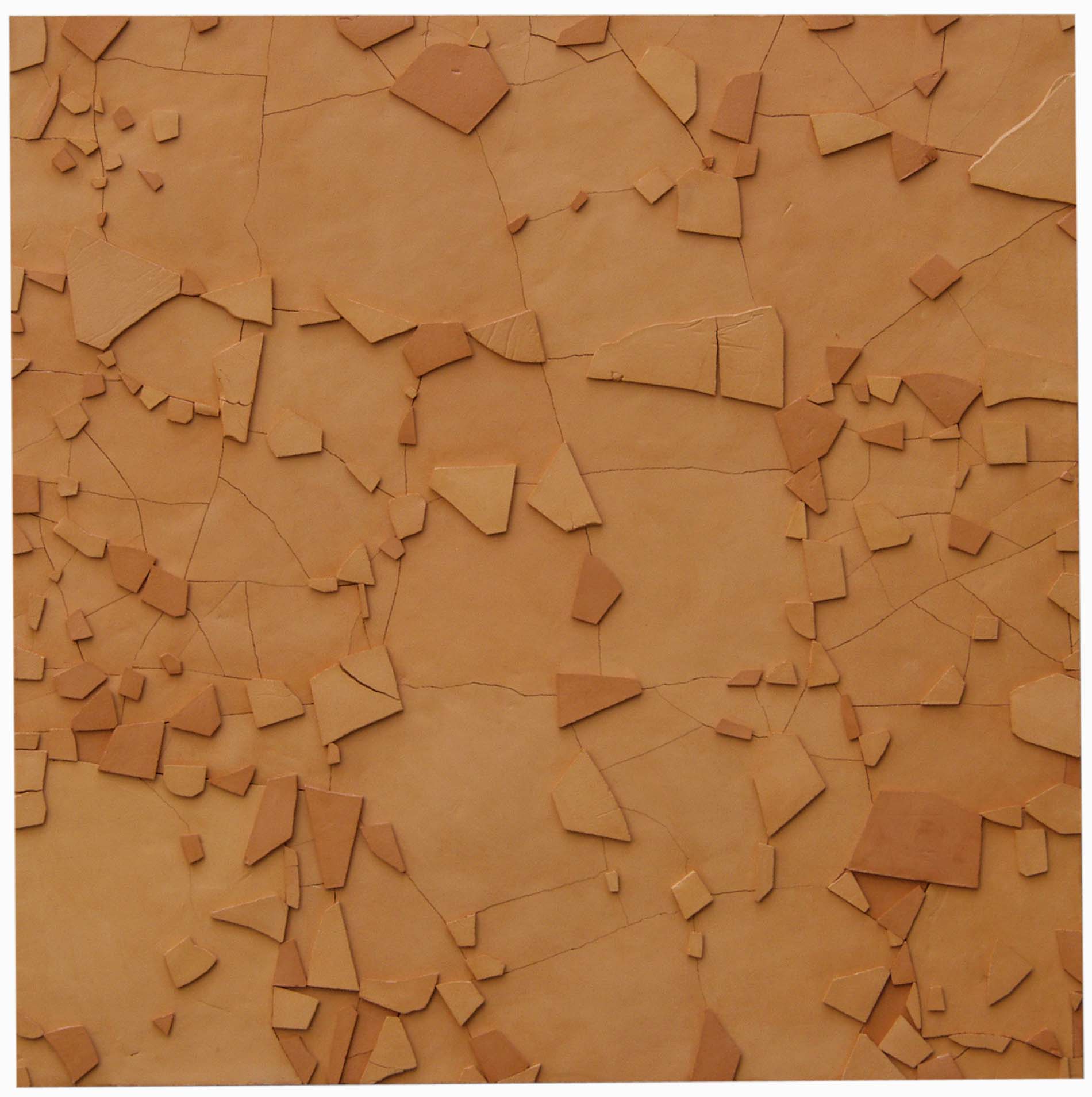
Luigi Mainolfi
Terra, 2007
Terracotta, 75 × 75 cm
Terra offers itself as a living surface, fragile and resilient at once. Terracotta - a primary, humble and authentic material - breaks, cracks, rises up like a geological crust surfacing from the depths. Every fragment, every crack is a trace, a mark of time, a detail to be read with both the eye and the hand.
Here Mainolfi invites us to consider sculpture as skin, as memory compressed into matter. The composition does not depict, it evokes: archaic landscapes, maps of remote, perhaps inner, territories. There is no centrality, no figure: only earth that breathes, moves, opens and fragments.
In this seemingly minimal surface, an ancestral echo resonates: the earth as origin, body and archive. Earth from which everything is born, on which one walks, which is worked, which is wounded. Mainolfi shapes matter with the respect of someone who knows it deeply, restoring to it voice and dignity.The work enters into a profound dialogue with the space of Cervino 28: a sculpture that does not seek to impose itself, but to be listened to, one that sinks its roots into Mediterranean culture and the value of the handmade gesture.