
Alberto Biasi
1937, Padua, Italy
A pioneering figure in kinetic and programmed art, Alberto Biasi was one of the founders of Gruppo N in Padua, with which he helped revolutionise traditional ideas of vision and perception. His research, which began in the 1960s, is based on the interaction between light, colour and movement, as well as on a continuous investigation into the viewer’s perceptual mechanisms.
Combining geometric rigour with optical illusion, his works invite viewers to experience the image actively and sensorially. Their appearance often changes according to the observer’s position.
In the Torsioni series, developed from the 1970s onwards, Biasi created a distinctive visual language composed of rhythmic patterns, overlapping strips, cuts and curves that intensify optical vibration. Represented in international museum collections and major exhibitions, Biasi is regarded as a central figure in the history of Italian and European perceptual art.
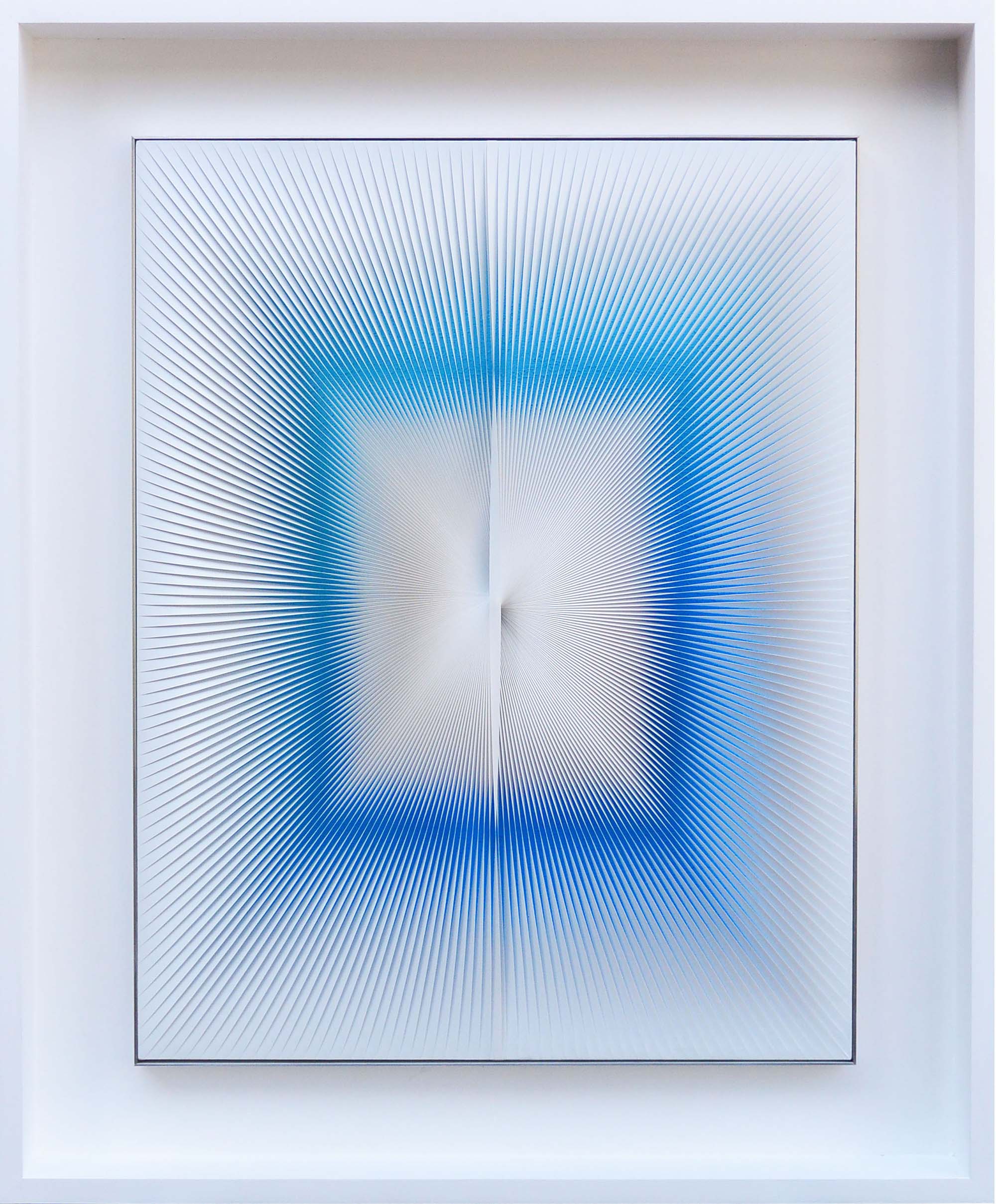
Alberto Biasi
Porta Celeste 1983
66x50 cm
In Porta celeste, Alberto Biasi presents one of his celebrated Torsioni, transforming the visual space into a dynamic and pulsating threshold. The grid of strips, arranged with mathematical precision, creates an illusion of depth and movement. This effect is intensified by the chromatic transition from white to blue, producing a luminous vibration that evokes a passage or portal towards another dimension.
Light becomes a structural element, while the centre of the work, resembling a narrow opening, suggests a tension between inside and outside, presence and absence. The image changes according to the viewer’s position, making the experience both perceptual and interactive.
The work combines analytical rigour with visual poetry, representing a significant expression of Biasi’s exploration of form as energy.
Learn more
Visit the artist’s website
(External link)