
Piero Gilardi
1942, Turin, Italy
Piero Gilardi is a key figure in contemporary Italian art, internationally recognised for revolutionising the relationship between art, nature and technology. Born in Turin in 1942, where he has always lived and worked, he made his debut in 1963 with the exhibition Macchine per il futuro, effectively anticipating many of the artistic and social tensions of the following decades. His Tappeti-Natura, made from expanded polyurethane, soon became icons of an art that seeks to recreate the natural world through artificial materials, arousing wonder but also raising questions.
In the 1970s he moved away from the art object to engage in collective and political projects, experimenting with forms of diffuse creativity in international contexts, from Nicaragua to Native American reservations, from Africa to urban peripheries. Returning to the art system in the 1980s, Gilardi began a new phase of research based on interaction with the public and the use of new technologies, pursuing an idea of art as a living, ethical and shared experience.
He founded PAV - Parco Arte Vivente in Turin, where all his experiences merged into an active, participatory and deeply ecological cultural project. His vision has influenced artists, architects, urban planners and activists, building a bridge between aesthetics, politics and the environment.
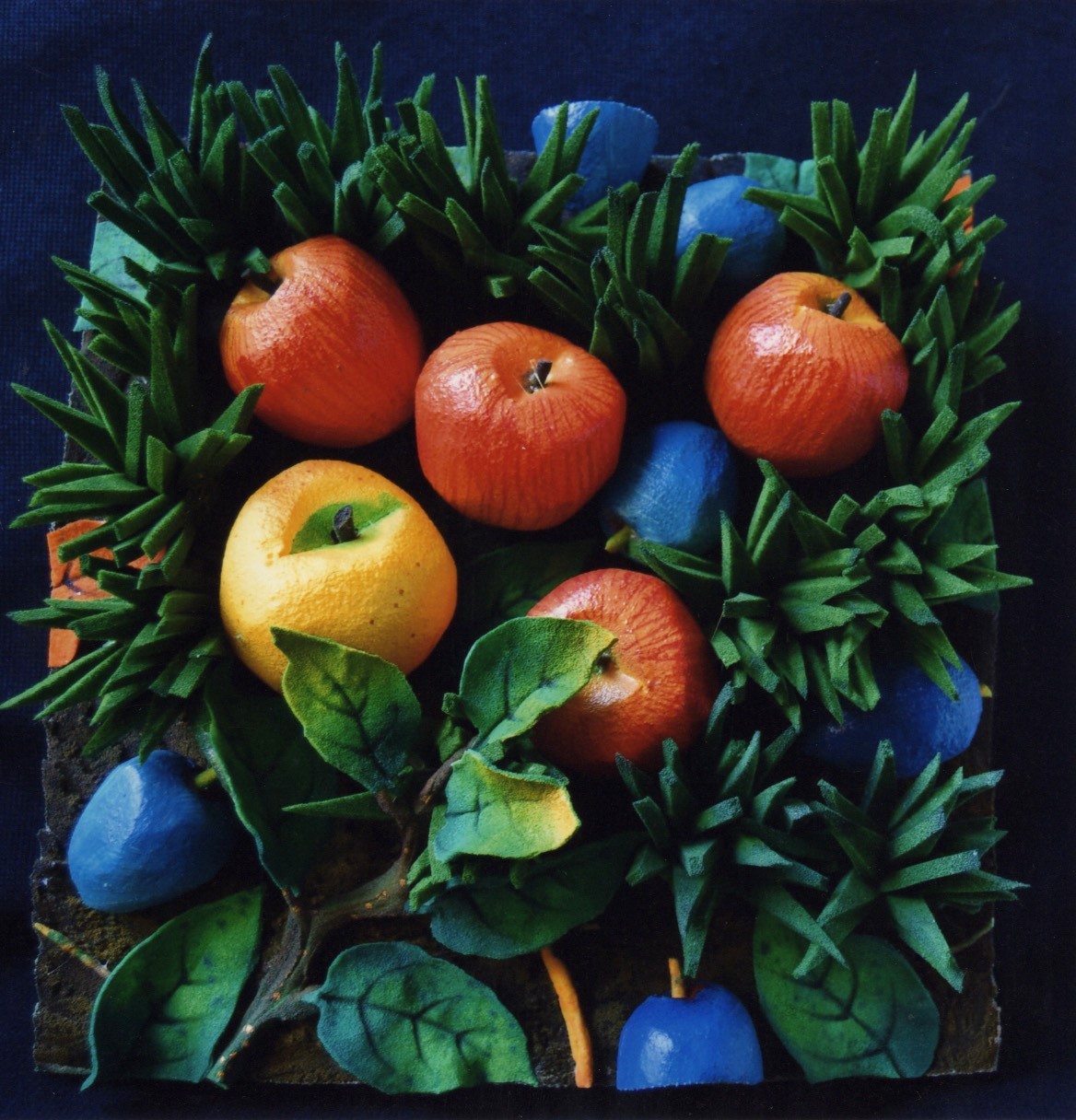
Piero Gilardi
Mele e Susine, 2000s
Expanded polyurethane and pigments on square base,
30×30 cm
With Mele e Susine, Gilardi revives the iconic power of his famous Tappeti-Natura, transporting us into a scene that is as simple as it is disorienting. Fruit and leaves in expanded polyurethane, rendered with astonishing realism and chromatic brilliance, emerge like tactile relics from an artificial world that imitates nature only to reveal its loss, its distance.
The work is a kind of hyperreal fake: it invites sensory wonder, but also reflection. Those apples and plums, perfect and motionless, will never rot. They are still icons of a synthetic Eden, one that questions our relationship with the environment, with consumption, and with the very memory of nature.
In Mele e Susine, irony, beauty, critique and nostalgia coexist. Gilardi does not imitate reality: he replaces it, making us feel how far we have drifted from it. In doing so, he once again confirms the visionary strength of his art, capable of speaking to multiple generations and remaining relevant even decades later.
Learn more
Visit the artist’s website
(External link)