
Giorgio Griffa
1936, Turin, Italy
Giorgio Griffa is one of the most consistent and rigorous figures in Italian conceptual painting. Born in Turin, where he still lives and works today, he has built a radical body of work, faithful to the idea that painting can reveal its own essence through the minimal gesture, the elementary sign, the rhythm.
From the late 1960s, Griffa abandoned figurative painting to focus on visual patterns stripped to the bone: lines, numbers, colours on raw, unstretched canvases, often left unfinished. The support becomes an integral part of the work: folded, marked, lived-in. In his works there is no representation, only trace, breath, time.
After a long period of partial eclipse, his work was rediscovered in the 2000s by critics and international museums, who recognised its philosophical depth and poetic radicality. His art is like a visual mantra: a practice of pictorial meditation that continues to question infinity with simple, subtle tools.
Giorgio Griffa
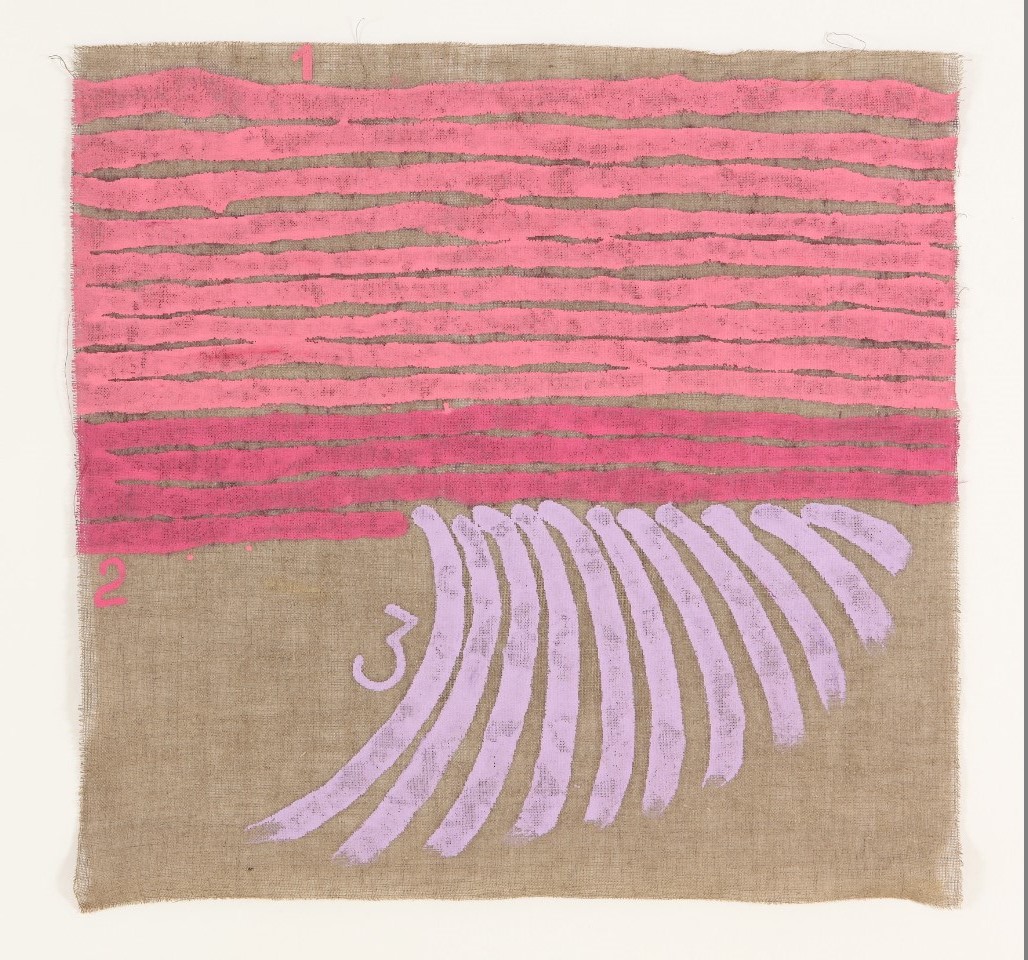
Tre colori, 1998
Acrylic on raw canvas,
70×71 cm
In Tre colori, Giorgio Griffa arranges three light horizontal bands of colour on the canvas, tonal vibrations in pink and lilac that seem to float on the raw texture of the fabric. The work does not seek perfection, but the presence of gesture, of time, of rhythm. The written numbers - 1, 2, 3 - are not a logical sequence, but traces of consciousness, punctuation marks in a silent grammar.
Every stroke has a beginning and an interruption, as if the work declared itself incomplete by nature, forever awaiting a continuation that must never come. The unfinished is not a lack, but an opening: a mental space left free for the viewer.
Giorgio Griffa
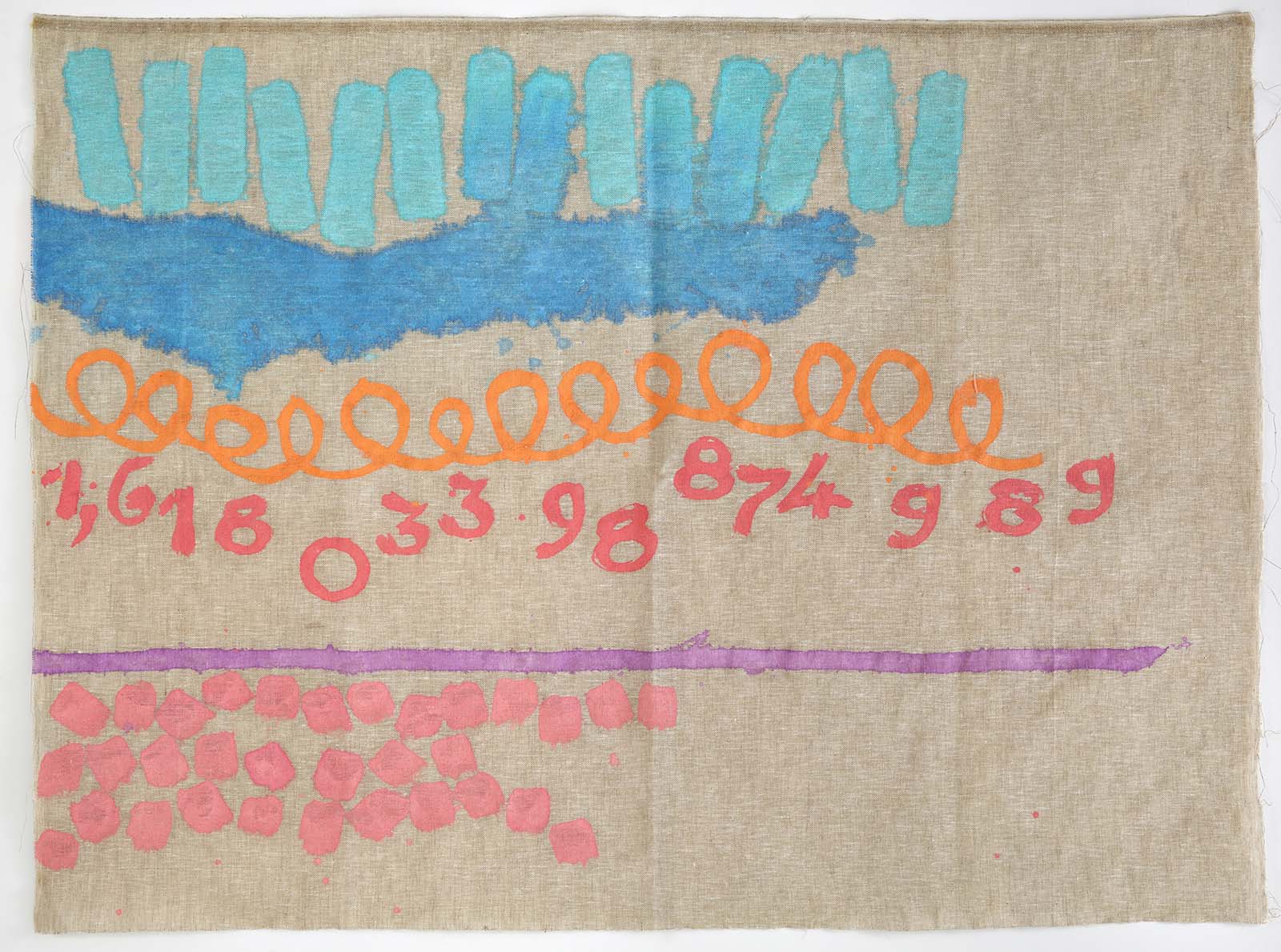
Sezione Aurea n° 989, 2010
Acrylic on raw canvas,
100×135 cm
In Sezione Aurea n° 989, Griffa's painting intertwines with mathematics and natural harmony. The sequence of numbers, the orange spirals, the blue and pink fields are ritual signs that evoke the invisible code of beauty. The golden number - 1.618... - is not merely a perfect measure, but a metaphor for a mysterious order running through nature, art and thought.
The brushstrokes seem traced with the lightness of an ancient script, one that does not impose but suggests. The painting unfolds in horizontal bands, like a text to be read with no obligation of beginning or end. The work is an exercise in balance between knowledge and intuition, between calculation and surrender.
Learn more
Visit the artist’s website
(External link)