
Massimo Kaufmann
1963, Milano, Italy
Massimo Kaufmann lives and works in Milan. Though he has always defined himself as a painter, over the course of his career he has worked across very different materials, languages and techniques, arriving at painting on canvas in a more radical way from the late 1990s onward.
His works are built through layers of colour, repeated rhythms and minimal variations that turn colour into atmosphere, vibration and visual time. Behind their apparent decorative lightness lies a rigorous, almost meditative discipline.
He has exhibited in major museums and international institutions, including the Fondation Cartier in Paris, PAC in Milan, GNAM in Rome, MAMbo in Bologna and the Pecci Museum in Prato.
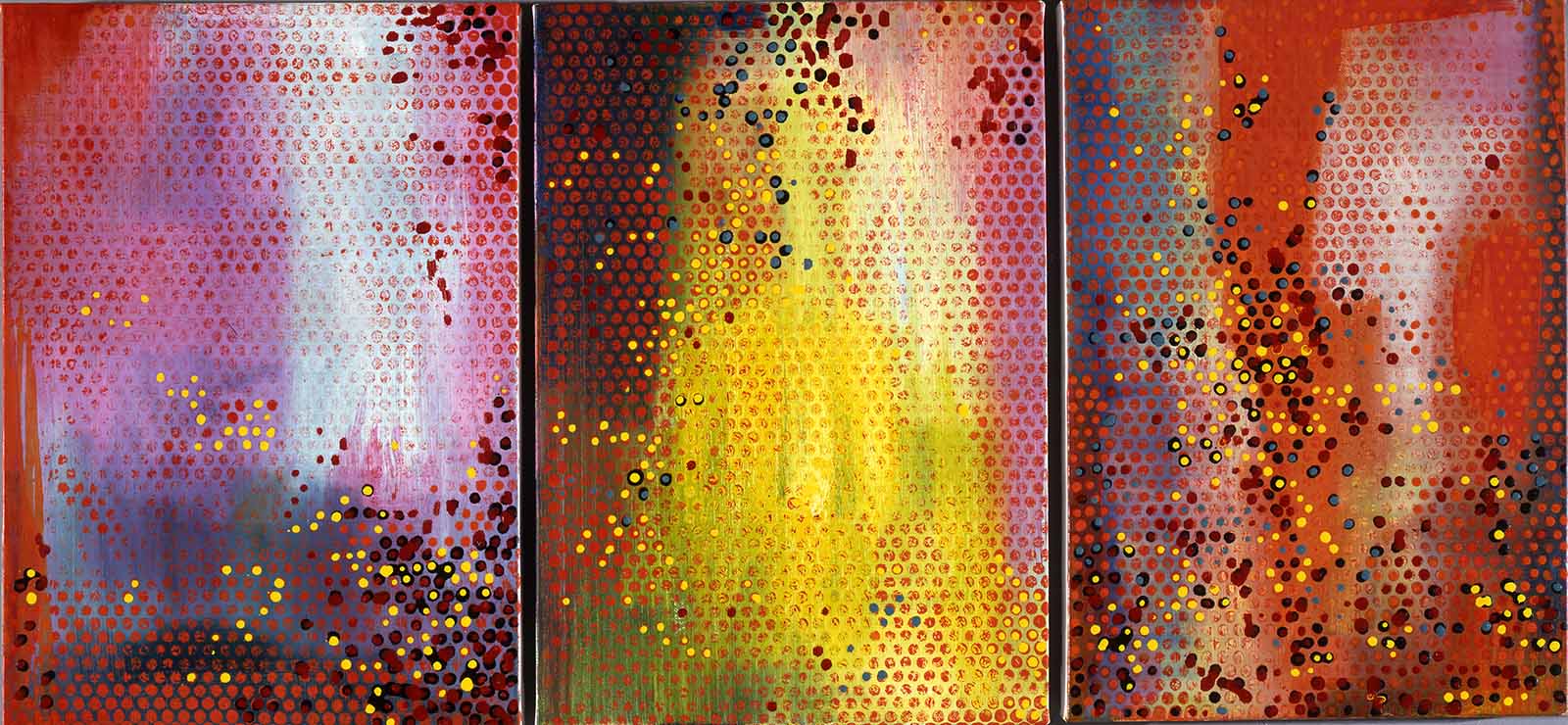
Massimo Kaufmann
The golden age (triptych), 2009
Oil on canvas
50 × 35 cm each
The first impression is of standing before something both microscopic and cosmic at once, as if the painting showed cells observed under a microscope, or distant constellations immersed in light.
The small coloured dots seem to move within the surface, gathering, dispersing, creating zones of density and sudden, breathable voids. Each panel of the triptych has a different atmosphere: the first colder and more rarefied, the central one almost explosive in its yellow light, the third more intense and nervous, crossed by a fragmented energy.
What is striking is that the work keeps changing depending on the distance from which it is viewed. From afar it appears almost decorative, luminous, elegant. Up close, one enters instead a very slow, obsessive process, built point after point, gesture after gesture.
And it is perhaps precisely there that one feels time within this painting - not as a narrated theme, but as a physical experience. Looking at the triptych, one has the sensation that the colour was not simply applied, but slowly accumulated, like memory or luminous dust left suspended in the air.